Industrial Automation Solutions: How PLC, HMI and Drive Integration Improves Production
Modern production depends on more than individual machines. A line may contain motors, sensors, conveyors, valves, safety equipment, inspection stations and operator panels from different manufacturers. Unless these components exchange the right information and respond as one coordinated system, the result can be unnecessary downtime, inconsistent output and limited visibility into what is happening on the factory floor.
Industrial automation solutions bring these separate elements together. A properly designed control architecture allows machines to execute repeatable sequences, operators to monitor conditions, motors to run at the required speed and technical teams to identify problems more efficiently. The objective is not simply to automate every manual task. It is to create a production system that is controllable, understandable and appropriate for the real operational requirement.
What Does Industrial Automation Include?
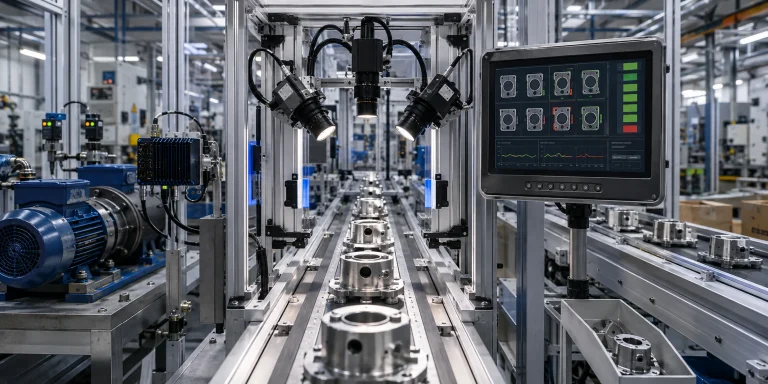
Industrial automation uses control systems, software and field equipment to operate or monitor an industrial process. The architecture varies by machine, production line and sector: a compact machine may need only a controller, operator panel and sensors, while a larger facility may connect multiple controllers, networks and supervisory software.
A typical system may contain:
- Programmable logic controllers (PLCs)
- Human-machine interfaces (HMIs)
- AC drives, variable-frequency drives and servo systems
- Sensors, encoders, switches and measurement devices
- Contactors, relays, valves and other output equipment
- Industrial communication networks
- Safety controllers, emergency circuits and protective devices
- SCADA, data collection or reporting software where required
These components must be selected and configured as parts of one architecture. A high-performance device cannot compensate for unclear process requirements, poor electrical design or unreliable communication between systems.
The Role of the PLC: Coordinating the Process
The PLC is commonly the central decision-making unit of an automated machine or line. It reads signals from field devices, executes programmed logic and controls outputs according to defined conditions. For example, a PLC may confirm that a guard is closed, detect that a product has reached the correct position, start a motor and stop the sequence if a fault occurs.
Effective PLC programming should reflect how the process actually operates. The programme needs clear operating modes, interlocks, alarm conditions, reset rules and fault responses. It should also be organised so that future engineers can understand and maintain it.
The Role of the HMI: Turning Data into Useful Information
The HMI is the point at which operators interact with the control system. It may display machine status, production values, alarms, recipes, trends and maintenance information. It can also allow authorised users to adjust suitable parameters or select operating modes.
A good HMI is not simply a collection of colourful screens. Information should be prioritised according to what the operator needs at each moment. Normal conditions must be easy to distinguish from warnings and critical faults. Alarm messages should help the user understand the problem instead of displaying an unexplained code. Clear navigation and consistent screen design reduce confusion and support faster decisions.
PLC and HMI integration therefore has an operational purpose: the PLC controls the process, while the HMI makes the process visible and manageable to people.
Drives and Motion Systems: Controlling Speed, Torque and Position
Many industrial processes depend on controlled motion. Pumps, fans, mixers, conveyors, winding systems and machine axes do not always need to run at one fixed speed. AC drives can regulate motor speed and torque according to process demand, while servo systems provide more precise control of position, speed and movement.
The drive must be selected according to the motor, load profile, duty cycle, control method, environmental conditions and required communication. Correct parameterisation is equally important to performance and equipment life.
When the PLC, HMI and drive communicate correctly, operators can view speed references and fault information from the HMI, while the PLC can coordinate motion with the rest of the sequence. This integration reduces isolated controls and creates a more coherent system.
Why Integration Quality Matters
Installing automation components does not automatically create an effective solution. The real value comes from how the system is engineered and integrated.
More Consistent Production
Defined sequences and controlled parameters help a machine repeat the same process under the same conditions. This can improve consistency and reduce variation caused by unstructured operation. The achievable result still depends on the mechanical system, materials, process design and maintenance quality, so automation should be evaluated as part of the complete production environment.
Better Operational Visibility
An integrated system can provide status information, alarm histories, cycle data and process measurements. Instead of relying only on observation, technical teams can use available data to investigate interruptions and understand operating patterns. The level of visibility depends on the selected sensors, software and data architecture.
Faster Fault Diagnosis
When alarms are structured properly and devices share diagnostic information, maintenance teams can narrow down the source of a problem more quickly. An HMI may show whether a sensor is inactive, a drive has reported a fault or an interlock is preventing a sequence from continuing. Clear electrical drawings and software documentation are essential companions to this information.
Greater Flexibility
Production requirements change. A company may introduce a new product size, modify a recipe or add equipment to a line. A modular control structure and carefully planned hardware capacity can make future changes more manageable. This does not mean that every system can be expanded without limits; expected developments should be discussed during the design stage.
Planning an Industrial Automation Project
Successful automation begins before hardware is ordered or code is written. The first stage is to define the current problem and the required outcome. Is the priority higher capacity, improved repeatability, safer operation, better traceability, easier maintenance or integration with another machine? A clear objective guides every later decision.
The project team should then document the process sequence, input and output requirements, motor and motion needs, operator roles, safety conditions, communication protocols and environmental constraints. Existing systems must also be assessed. Voltage levels, panel capacity, network infrastructure, machine condition and compatibility with installed equipment can significantly affect the project scope.
Testing and commissioning deserve the same attention as design. Control logic, alarms, interlocks, operating modes and fault responses should be verified systematically. Where practical, parts of the software can be tested before installation. Final commissioning must be performed under actual operating conditions with appropriate technical and safety controls.
Documentation should not be treated as an optional final task. Updated electrical drawings, parameter records, software backups, device lists and operating information support maintenance and future development. Without them, even a technically successful system can become difficult to manage.
The OKSO TECH Approach to Automation
OKSO TECH combines engineering, software and system integration capabilities to evaluate industrial automation requirements as complete projects. Our process begins by understanding the machine, production objective and current constraints. We then clarify the control architecture, hardware requirements, communication structure, software scope and implementation conditions.
Depending on the agreed project, support may include PLC and HMI applications, drive and motion integration, control system planning, software integration, technical coordination, testing and implementation support. Every project is evaluated according to its technical feasibility, operating environment and defined scope.
Serving customers since 2015 and drawing on experience from more than 1,000 completed projects, OKSO TECH focuses on structured communication and practical solutions. We do not assume that the most complex system is automatically the best one. The right solution is the one that meets the required function with suitable reliability, maintainability and room for realistic future needs.
Frequently Asked Questions
Can an existing machine be upgraded without replacing it completely?
In many cases, selected control components can be modernised while suitable mechanical parts remain in service. The correct approach depends on the machine’s condition, existing documentation, safety requirements and compatibility of the installed equipment. A technical assessment is required before the scope can be confirmed.
What is the difference between a PLC and an HMI?
A PLC executes the control logic and interacts with field devices. An HMI presents information to the operator and allows permitted commands or parameter changes. They perform different functions but normally work together within the same control system.
Can automation data be connected to other software?
It may be possible to transfer selected production or status data to SCADA, reporting, database or enterprise applications. The available method depends on the controller, communication protocols, cybersecurity requirements and software architecture.
Build a More Connected and Controllable Production System
Industrial automation is most effective when control logic, operator interfaces, drives, field equipment and software are designed to work together. A well-planned solution can support consistent operation, clearer diagnostics and better preparation for future production needs.
If your company is planning a new machine, upgrading an existing line or connecting separate industrial systems, contact OKSO TECH. Share your process, current equipment, required outcome and available technical information. Our team can evaluate the request and help define an appropriate industrial automation path.